Description
Who is this course for?
This course is ideal for those who have painted at least one icon or have prior experience in painting. If you’re looking to develop your technique while exploring a more expressive, spiritual approach to iconography, this course will support and inspire you. Artists are also welcome.
What do you need?
You can either use the materials that you already have. Or acquire materials from the list below. Please contact us if you need any advice.
Materials needed for the Course:
You won’t need all the materials for your first session as it will be an introduction. Please contact us if you want to sign up but not sure if you manage to get all materials before the start of the course.
- Gesso panel: Recommended size 20cm x 30cm. You can order a proper icon board or use a Clayboard
- A4 tracing paper
- Brushes: Squirrel mix – sizes 2,3 and kolinsky size 0 (Vegan alternatives available)
- Pigments: Titanium White, Cadmium Red Light, Ultramarine Blue (Red Shade), Chromium Green Oxide, Yellow Ochre, Red Ochre, Cyprus Burnt Umber, Antique Green, Mars Black, and Cobalt Blue Deep.
- Ceramic palette
- Gold leaf. 5 leaves is enough
- Gold size – smallest bottle
About the icon of The Holy Trinity
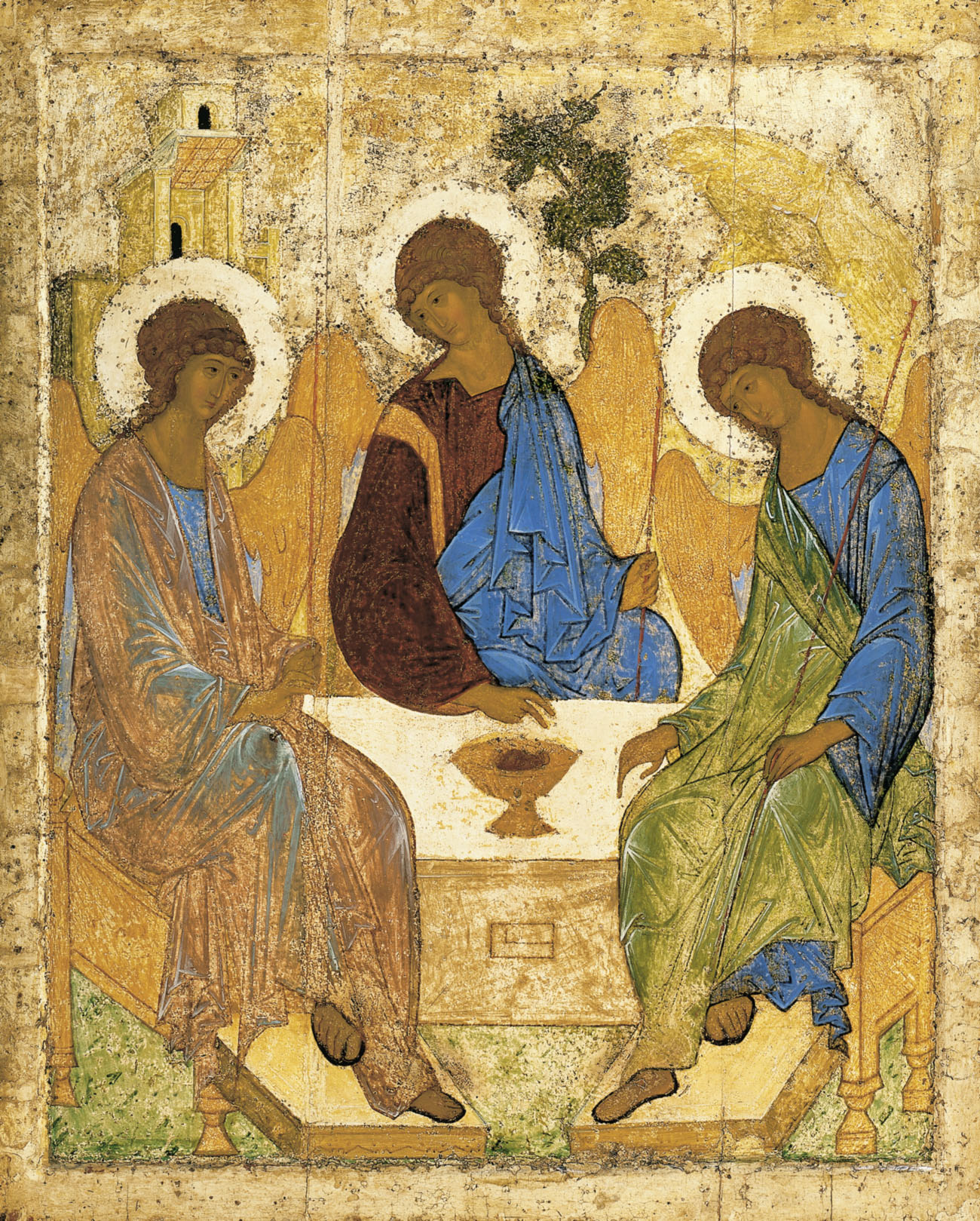
We will work using three different icons of The Trinity as a reference. Of course the original icon painted by Andrei Rublev will be our main focus. We will need the other icons painted in contemporary times to give us more detail as Rublev’s icon is very old and it lost a lot of detail. If you want you can prepare by studying different icons of The Trinity based on Rublev’s image. Please do reach out if you need advice which images are good quality.
Andrei Rublev’s Holy Trinity icon, painted in the early 15th century, is a masterful example of balance, clarity, and refinement in icon painting. Three angels are seated around a table in a harmonious circular composition, their gestures and gazes creating a sense of unity and quiet cohesion. The work is known for its subtle colour palette, elegant lines, and carefully structured rhythm.
Earlier icons of this subject depict the visitation of Abraham and Sarah (Genesis 18) as a narrative scene, including the hosts, architectural details, and multiple elements that situate the event in time. Rublev simplifies the composition significantly. By removing Abraham and Sarah and reducing the setting, he focuses entirely on the three figures. This shift moves the image away from storytelling toward a more symbolic and theological representation, marking a key development in the history of iconography.
Meet Your Instructor – Basia Mindewicz
Basia Mindewicz is a highly respected icon painter and contemporary artist with extensive experience in both traditional and modern styles. A graduate of the College of Iconography in Poland, Basia has led numerous icon painting courses and workshops across the UK and internationally. She is the founder of the Edinburgh School of Icon Painting, and her work blends ancient techniques with personal, contemporary depictions of human spirituality and truth.
Reviews
There are no reviews yet.